Wednesday, January 4, 2012


The image above is the cover of a gift catalog/magazine (that I’m certain was expensive to produce) from La Grande Épicerie de Paris in Le Bon Marché department store (38 rue de Sèvres, 7th arrondissement). I picked it up in December of 2009, and though you can’t tell from the image, you can actually turn the serrated wheel at the right so that the colors change in the cut-outs of the gift boxes. I think it’s such a beautiful publication that I can’t bear to get rid of it, and besides, looking through it reminds me that La Grande Épicerie is a fabulous one-stop shop for wonderful culinary gifts (for others, but also for yourself!).

It also reminds me how much I love Paris’s grands magasins (department stores), and how often I tell people not to overlook them. It’s not just about the shopping: Galeries Lafayette, for example, has a gorgeous, mosaic glass domed ceiling that is every bit worth seeing as any other Parisian landmark, and the façade of Au Printemps was registered as a historic monument in 1975. In addition to Galeries Lafayete, Au Printemps, and Bon Marché, the other grands magasins include Bazar de l’Hôtel de Ville (BHV) and, formerly, La Samaritaine, now closed. In some ways I liked La Samaritaine best of all. The store was founded by Ernest Cognacq and his wife, Marie-Louise Jay (yes, the very same names associated with the wonderful Cognac-Jay Museum in the nearby 3rd arrondissement, housing one of the finest private collections of 18th century painting and objets d’art). Cognacq reportedly began selling ties on the Pont Neuf at a site previously known for a water pump located under an arch of the bridge. The pump provided water to the community from the early 1600s to the early 1800s, and it bore a bas-relief of the biblical Samaritan woman drawing water for Jesus at the well. I suppose Ernest and his wife had no trouble thinking of a name for their store when it opened in 1870. La Samaritaine was enormously successful until the 1970s, when it began operating at a loss, and it closed in 2005. I didn’t buy many things there but I loved the store for its rooftop café, Toupary (I love that pun!). I always heard the food was mediocre so I only ever had coffee and wine there, but what I came for was the view, which was spectacular and gratuit – everyone was welcome to come and look out at the Seine and the rooftops and beyond. Luxury goods company LVMH now owns La Samaritaine, and in 2010 it was announced that the Japanese firm Sanaa had been chosen to redesign the property. A 450 million euro project – apparently the largest privately funded construction project ever undertaken in Paris – will turn the former store into a luxury hotel and three adjacent properties will be dedicated to offices, shops, 95 apartments, and a nursery.

On nearby rue de Rivoli and founded in 1856 is BHV (that’s pronounced BAY-AHSH-VAY and it was abbreviated in 1982), which also has a rooftop terrace that practically nobody seems to know about. I discovered it quite by accident, and I couldn’t believe my luck – besides me, there were only three other people up on the roof and the view, while not as great as at Samaritaine, was still terrific. There is not a café here, which is probably why few people know to come up. The stationery department and the sous-sol (basement, which is devoted to hardware and kitchenware gadgets; you can buy cool stuff you can’t find in the States here, like drawer pulls and knobs that say “chaud” and “froid”) are the only areas I’ve ever bought anything.

Galeries Lafayette (founded in 1893) and Printemps (founded in 1865) are neighbors on the boulevard (Haussmann) so they’ve long been fierce rivals. I like just standing in the Lafayette Coupole building with its Belle Epoque architecture, but I also like the Home building (across the street) and, of course, Lafayette Gourmet (though in my opinion it is not nearly as appealing as the Épicerie at Bon Marché). Also, there are free fashion shows, which can be great fun, every Friday at 3:00 on the 7th floor in the Coupole building. A man named Jules Jaluzot was the creator of Au Printemps, which had an unfortunate start when a fire destroyed nearly all of the original building. But when the store reopened, in 1883, it was unique in two regards, according to the store’s website: it was the first to have electricity, and the first to have set prices for its merchandise (bargaining had been customary, but according to Catharine Reynolds in ‘Paris Journal: The Great Department Stores’ [Gourmet, October 1993], the practice of fixed prices was begun at Bon Marché). Believe it or not, a second fire occurred in the early 1920s, but since that time the store has been spared further destruction (and underwent a major restoration in 2006). My favorite place to be in Printemps is the Brasserie, which features a gorgeous, Art Deco cupola. And the 9th floor offers an unobstructed view from the Opéra to the Madeleine and from the Eiffel Tower to Montmartre.

But back to Au Bon Marché (as it was originally called, in 1852, by its founder, Aristide Boucicaut): I think it has the jewel in the department store crown with the Épicerie. I have spent a lot of euros (and former francs) here buying chocolate (the Valrhona selection is far more extensive than what is available in the States, plus there are always several brands that I’ve never heard of; and I also bought a chocolate watch for my daughter!); dragée chocolate almonds covered in gold, silver, and copper (typically only available around the December holidays); Kusmi tea (again, lots more varieties on offer); a box of marrons glacés; A.O.C. olive oil from Nyons (among my most favorite); exotic salts; smoked salmon; and even an accroche-sac, one of those gadgets that you slide over a table edge and hang a handbag on (mine is “decorated” with the Epicerie website, http://www.lagrandeepicerie.fr/).

If you’ve read this far and are wondering if I’m just rambling on about the grands magasins for seemingly no good reason, in fact I’m doing so because January is one month of les soldes (sales) in Paris and I know a number of people who plan trips around these big sales. Les Soldes are nationwide and state-regulated, and, according to the authors of one of the best books about France ever written – Sixty Million Frenchman Can’t Be Wrong by Jean-Benoît Nadeau and Julie Barlow (Sourcebooks, 2003) – they predate the discovery of America by at least three hundred years. Nadeau and Barlow note that “the police set the dates and supervise the sales across the country: stores are only allowed to have sales from mid-January to mid-February and from mid-June to mid-July. To hold a sale outside that period, merchants have to obtain special approval from the police. The rest of the year, small shops and big retailers can’t so much as offer a rebate without facing the wrath of the law.” I have read, however, that due to the faltering economy, the government has recently been allowing stores to mark down merchandise outside of les soldes. The Winter 2012 sales begin next week on 11 January and run for six weeks, ending on the 14th of February.

As each week passes, prices are slashed further, so it’s possible to get an outstanding bargain, even on designer items. But as with sales anywhere in the world, it pays to be knowledgeable about pre-sales prices to determine how good (or not) a deal you’re getting. Savvy shoppers will visit the stores in advance of the sales, especially to try on clothes for sizing – it will be a madhouse once the sales begin, so if you already know what size to buy you will save valuable time. Waiting until the end of the sales is not necessarily advantageous for clothes shoppers as by that point there will be limited sizes available. If you’re not going to be in Paris but you’d like to take advantage of les soldes, the bigger stores – notably the grands magasins – ship outside of Europe (I’m not sure of the policy for smaller boutiques), and if you are comfortable with an all-French website, check out http://www.1001bonnesaffaires.com/, which is excellent.

I would be remiss if I didn’t mention another of my favorite features of les grands magasins: their restaurants and cafes! Whether you are actually shopping or just walking by one of the stores and feel like taking a break, don’t overlook the dining and picnic possibilities these stores offer. For the most part, what you’ll find is far better than anything in North American department stores, even at the coffee bars, and you’ll have an array of choices. Author and writer Peter Hellman, whose piece “Why We Love French Wine” is in my Paris book, has thoroughly investigated Paris department store dining over the years. I used his piece for the travel section of The New York Times – “For Hungry Shoppers in Paris,” 28 January, 2001 – as a primer for several years, but his more recent piece – “How to be a Gourmet in the Paris Stores,” The Wall Street Journal Online, 29 July, 2010 – may be of more interest.

Lastly, I close with a sentence worth keeping in mind from a very useful book by Susan Swire Winkler and Caroline Lesieur, The Paris Shopping Companion: A Personal Guide to Shopping in Paris for Every Pocketbook (Cumberland House). “In a culture where style of life is a source of national pride and pleasure, shopping as the French do is an invaluable approach to understanding French culture.”


Thursday, December 22, 2011


A number of friends and colleagues have been asking me for gift ideas for people they know who love Paris and France, and Tuscany and Umbria and Italy, and Istanbul and Turkey,...and therefore who also love art, music, history, and travel in general. Short of an airplane ticket or a hotel gift certificate, I always reply that the best gifts for people who love travel are books, and I don't say that just because I am an author. Rather, I truly believe that books (in any format) offer what literate, curious travelers want most: depth, background, and inspiration.

Without doubt, the book I am recommending most often right now is the one pictured above, The Louvre: All the Paintings (Black Dog & Leventhal, published on November 14th). This is no ordinary book, and it is not an updated version of a book previously published. It is a ground-breaking, extraordinary, gorgeous, must-have work of art itself, and it features every single painting in the Louvre's permanent collection. Every one. Three-thousand and twenty two of them. The book is 766 pages, it weighs a number of pounds (I'm not sure how many, but you need two hands to hold it), it's accompanied by a navigational DVD-ROM, and it's $75. And it's a perfect gift, even one for yourself.

Readers of my Paris book know that I am hugely fond of the numerous small museums in the city, whether devoted exclusively to a single artist (Delacroix, Picasso, Rodin, etc.) or to collections (Jacquemart-Andre, Cognacq-Jay, etc.). But there is no doubt that my most favorite museum on earth is the Louvre, the largest single museum in the world. When I was a student in the Hollins Abroad Paris program in 1979, my art history classes were held once a week at the Jeu de Paume (which then housed the French Impressionists) and once a week at the Louvre. We were required to go to each museum a second time each week to complete homework assignments, but I always returned to the Louvre a third time, every Sunday, when it was free (today it is free on the first Sunday of every month, as well as on Bastille Day and on Fridays after 6:00 p.m. for anyone under age 26). I loved (and still do) the enormity of the museum (I like knowing that I will never see everything), and I loved the beautiful parquet floors in the galleries and I loved the periodic views out the windows and I loved seeing the 'Winged Victory of Samothrace' sculpture that was then at the top of a stone staircase. Most of all I loved the paintings, some of them the largest I'd ever seen.

I know I'm not alone in my love for the Louvre -- it is the most popular art museum among Americans traveling abroad, who represent nearly 1 million of the museum's 8.5 million annual visitors -- and at the celebratory party for this new book last month I met a lot of other fellow Louvre enthusiasts. The party was given by American Friends of the Louvre, and I was initially embarrassed to realize that I'd never heard of AFL, but I now know that this terrific, non-profit organization was only founded in 2002, so I don't feel so ignorant. In addition to fostering collaborations between the Louvre and American institutions with exhibits, educational programs, and scholarly exchanges, AFL also helps finance Louvre projects such as renovations of galleries, restorations, fellowships, and educational programs both in France and in the U.S. AFL has provided grants benefitting all eight curatorial departments of the Louvre, and among the projects it has supported are the creation of Cy Twombly's 'The Ceiling' in 2008; fellowships in Islamic art and American art, 2005-2009; restoration of Greek and Roman antiquities in 2007; and the English version of Atlas, the museum's online collections database with access to the 35,000 works on display. Currently, AFL has pledged to raise $4 million to support the restoration of the museum's 18th century Decorative Arts Galleries, designed by Jacques Garcia and scheduled to re-open in 2013. Additionally, AFL has raised $146,000 toward a conservation program for the Louvre's extensive holdings of pastel drawings.

(Now that I think of it, a truly generous and meaningful gift would be a copy of the book along with, say, a bottle of French wine, some Mariage-Freres tea, a French press and some coffee, or even a bottle of Badoit avec gaz and a membership to AFL (there are 6 levels of membership, ranging from $500 to $25,000 a year). Membership at the Chairman's Circle level ($10,000 for 2 people for 1 year) entitles you to an annual trip to Paris focused on a major exhibition or theme at the Louvre. The description of the 2011 spring trip was among the most distinctive I've ever heard of, including a trip to Metz to visit the Pompidou Centre's new outpost; a private tour in the Louvre on a Tuesday (when the museum is closed to the public); cocktails at the Delacroix museum; visits to the Chateau de Vaux-le-Vicomte and Chateau de Sully; lunch at the Chateau de Courances hosted by the Comtesse Serge de Ganay and the Marquise de Ganay and a tour of the home and gardens; and dinner in the home of a Parisian collector. Wow. AFL is at 60 Fifth Avenue in Manhattan / (212) 367.2645)

At the book party, the Cultural Counselor of the French Embassy, Antonin Baudry, gave the introductory remarks to all of us gathered there in a beautiful room. I was particularly drawn to his comments that, "All together, we are 'les Amis du Louvre' (what a beautiful formula!) because we are friends of art. We are also, I hope, a community that embodies more generally the friendship between France and the U.S. Art is a bridge, as we all know. Between countries, nations, or people. Also between body and soul, the work and the eye, matter and spirit." Baudry later said that a book is not only a book: "A book is a world. Just like a museum: the pages are open, the walls are windows. Body and soul, I said. Matter and spirit." Precisely.

The Louvre: All the Paintings is authored by a ridiculously talented foursome, Erich Lessing, Vincent Pomarede, Anja Grebe, and Henri Loyrette (Loyrette has been Conservateur General du Patrimoine since 1975 and President and Director of the Louvre since 2001, but each of these authors have very impressive credentials). Paging through this monumental edition is an absolute pleasure as I see works I consider to be old friends but I also see others for the first time. And what is especially appealing about a book of this sort is that I can choose to turn to a particular artist or school of painting (in the case of the Louvre these include Italian, Northern, Spanish, and French) and just get lost in it all. Literally, every day since I've had a copy of the book, I cannot wait to spend time with it. Each day has been filled with this lovely surprise.

It's easy to say that this book is for Francophiles and everyone for whom Paris holds a special place. But the truth is it's a book for any art lover, any traveler, any museum goer, any human being who appreciates beauty. Or, as Henri Loyrette states best in the book's Preface, through this illuminating volume, "all people -- from scholars to tourists, art professionals to students, the "learned" to the "unknowing" (to paraphrase the French philosopher Denis Diderot) -- will be able to reflect upon and preserve in their memory the paintings of the Musee du Louvre."


Warm and joyeuses wishes to everyone at this almost-end of 2011! My next posting will appear in early January.

Friday, December 16, 2011


Perhaps I’ve been lucky, but I don’t think it’s been luck that has allowed me to bring back many souvenirs in my luggage without any mishaps. I have carefully packed bottles of olive oil, wine, liqueurs and jars of condiments; Venetian glass candies; and various pieces of ceramics and none have ever broken. I have also carried delicate lavender wands from Provence, prints and etchings, and glass perfume bottles from Morocco, and all survived happily in my carry-on bag (I always pack an empty tote bag in my luggage, and this becomes my carry-on bag when I’m leaving my destination). I use my worn articles of clothing to wrap around fragile items but I also usually bring some plastic bags and some bubble wrap. And I keep in mind something a UPS driver once told me: you should pack a box (or a piece of luggage, in this case) so that if it falls from a second story window nothing will break.


I have also had some items shipped on a few occasions, again with positive results. But I’m well aware that some travelers have had items break, whether they packed them on their own or had them shipped from a merchant.


Recently, my good friend Linda, who went to Italy for the very first time in October, had one of these experiences, and it reminded me that it’s worthwhile to share these stories, so here is Linda’s:


“Although I bought many souvenirs, the one thing I wanted most was a ceramic keepsake made by hand, preferably painted in bright colors. I liked the idea that I would be the only one in Brooklyn to have such a piece. Though I didn’t do much research into Italian ceramiche, I could tell that the ceramics on display at the street vendors along Via dell’Ariento in Florence were not to my liking. Then, on our last night, we were strolling along a little street near the Ponte alla Carrala, we came across what I hoped to find - a window display of beautiful ceramic lemons, platters in all sizes, with every detail glowing in the nighttime light. The store sign, made also of ceramic, simply said Giotti Ceramiche (Borgo Ognissanti, 15r, http://www.giotti.net/).
I was hopeful there would be at least one piece I could afford, and when I returned in the morning I was so happy to buy not one but two unique pieces: a basket of lemons with grapes and a serving platter with a painted scene of a podere (estate or farm), cypress trees, and red poppies. I asked the staff at Giotti to have my items shipped, and we traveled on to Venice.


One week later, a box arrived from Giotti, but it was a flimsy box and I thought I heard a rattle as I carried it to my apartment door. Yes, my lemon-and-grape basket was broken -- one of the delicate leaves was chipped off -- and I was sad and slightly angry because the nice man at Giotti had assured me they package items like this all the time with complete success. When I was at the store I never asked about guarantees or refunds, but now I needed to tell them what happened and see what they would do. I took pictures of the box and pictures of the lemon-and-grape basket and sent an e-mail to Giotti. Within minutes, Laura (a Giotti employee) responded. After a few e-mail exchanges, Laura confirmed that a replacement piece would be in production immediately and that I could keep the broken one. She would look into why the packaging was faulty and would make a note for future shipments. Within 3 weeks a new box arrived and this box was strong and taped well and was clearly marked (and best of all there was no rattle sound when I picked it up). My new lemon-and-grape basket is now sitting on my kitchen table, and every time I walk by it I think of my first trip to Florence and my walk at night along that little dark street. But I also think that when I return to Florence (and I most definitely will return), I will go to the Giotti shop and give Laura a big hug (and buy some more ceramics!).”


Though Linda should have inquired about Giotti's policy on shipping before she left the shop, she carefully documented what had happened and took photos when she was home, and her story has a happy ending.


(Full disclosure: I happen to be the recipient of the original lemon-and-grape basket with the chipped leaf, and I completely understand why it caught Linda's eye! Linda knows I am nuts for ceramics, too, and I was only too happy to add this decorative piece to my collection. But beyond the usefulness and practicality - or just plain beauty -- of ceramics, one of the best reasons I seek them out is for the memories associated with buying them. Like Linda's memory of discovering Giotti's window in that little Florentine street at night, I remember where I bought every piece I have, making their value inestimable.)

Monday, December 12, 2011

I just realized I’d forgotten to mention some other books I’ve read since my Tuscany and Umbria book was published last year that I very much want to enthuse about, but since my last post was a little long, perhaps it’s better that I forgot them. In fact, this post will be a little long, too, and it’s devoted to only one book; but I think you’ll agree that this one, which is rather hard to accurately describe and that makes the word 'unique' sound trite, is worthy of its own post. (And it makes a very wonderful gift.)

I have never, ever seen a book quite like Slow: Life in a Tuscan Town by Douglas Gayeton (introduction by Alice Waters, preface by Carlo Petrini, Welcome Books, 2010), and happily it is a perfect example of a book that will never (or never should, anyway) translate into an e-book format: with a trim size of about 13" across x 11 1/2" from top to bottom, this is a book that's meant to lie horizontally, especially when you come across one of the fold-out spreads that opens to about 36" across. There are just certain types of books -- namely, those covering art and photography -- that simply must be read and viewed on bound pages.

Slow has a generous amount of text but is essentially a book of photos by Gayeton, a multimedia artist who has created award-winning work for National Geographic, PBS, Warner Brothers, and Sony. The book documents the years he lived in Pistoia, among my favorite Tuscan towns and one that many Americans never visit (more about Pistoia in an upcoming post). In the beginning of Gayeton's time in Italy he is dating an Italian woman, and becomes very close to her family; but even after she leaves to live in the States, he maintains a close relationship with her family members and meets many other locals in Pistoia who earn a place behind his camera lens. So there are many people who appear in these sepia-toned photos, and in most of them Gayeton has written in script around the edges of the pages, and around the heads of the people, describing the scenes. This, Gayeton informs us, he was inspired to do after one of his many visits to the Uffizi -- where "I could practically walk through the museum blindfolded" -- and among his favorite works are the smaller, pre-Renaissance paintings that incorporated narrative devices like "words floating in air" and "rays of light emanating from the heads of saintly figures" and "even diagrams and lengthy texts were painted directly on the canvas." When you see this book, you will understand immediately what he's referring to as the text in and around his photos is in English and Italian, and one of my most favorite attributes of the book is Gayeton's use of everyday Italian phrases (many slang) and their translation into English. Among these are A tavola non si invecchia mai (at the table one never grows old, a Tuscan proverb); Fuori dai piedi (literal: away from your feet / figurative: get out of my hair!); Meglio solo'che male accompagnato (better alone than in bad company); Conosco i Miei polli (I know my chickens, an Italian saying); Morto io morto il mondo (when I die, the world dies, also a Tuscan saying); Le morte non guarda infaccia a nessuno (Death looks no one in the face," also a Tuscan proverb); Questa vigna non fa una (literal: this vineyard doesn't make wine / figurative: you can't get anything out of him); Nelle botte piccola c'e vino buono (literal: in the small cask there's good wine / figurative: good things come in small packages); Tutti in piazza (literal: everyone in the town square / figurative: take to the streets); Fare due chiacchiere (literal: to make two (gossipy) comments / figurative: to have a chat); Scopa! (a game of "scopa" halts when the men notice a group of young women crossing the street; the word means a card game, a broom, and to have sex); and Meglio spendere soldi dal macellaio che dal farmacista (better to spend money at the butcher than the pharmacist, an old Tuscan proverb passed down by the father of Dario Cecchini, the colorful, Dante-quoting butcher of L’Antica Macelleria in Panzano-in-Chianti). It doesn’t come as a surprise to learn that, as Gayeton notes, "most Italian sayings had evolved from the wisdom of peasants."

In addition to the fold-outs, there are a few of those pages where you lift the clear plastic to see the unembellished photo beneath, like those current and imagined drawings of Ancient Rome, for example, or Pompeii. I am crazy for this kind of thing, especially in a large format.

The story in the middle of all this family and of Pistoia is food, and Gayeton writes that "when I first moved to Pistoia I discovered that people here lived slow lives without knowing what Slow Food was. They were connected to the land, to the seasons. They not only knew their food but often who grew or made it." On the spread entitled 'Una Scampagnata' (scampare + campagna = to take a walk in the country), we are introduced to Daria, a cook at Villa di Celle, outside Pistoia. Her grandmother taught her how to hunt for wild salad, and Gayeton tells us that "it will take over an hour to pick and another to wash the dirt and bugs out of this salad (that's slow food)." Daria wisely asks, "who will know about such things after we're gone?" Gayeton doesn't have an answer, but a book like this certainly honors the food traditions of Tuscany and of Italy, and I believe that the people who read it are paying attention and spreading the word.

The real gift of this book is that you will learn an awful lot about Italian customs, culture, quirks, and language. You have to look at every photograph and read every surrounding word, and you'll find that even by just turning a few pages a wealth of knowledge is revealed. This kind of book can only be created by someone who is not only extremely observant but who really looks, smells, eats, listens, and ponders, someone who has the advantage of staying for a long while but more importantly sits patiently and soaks it all in. As Slow Food founder Carlo Petrini notes in his Preface, Gayeton's photographs and words "are rich and undeniably authentic, and could only have been made by someone with a deep sensitivity and understanding that goes beyond the boundaries of nations and languages, and represents the principles at the very heart of the Slow Food movement."

Perhaps surprisingly, if only because you expect to read that he still lives in Tuscany, Gayeton now lives on a farm outside Petaluma, California with his wife (who he met in Tuscany, though she's American) and daughter. Laura (his wife) started the first goat's milk ice cream company in the U.S., and they have their own chickens, roosters, goats, and cows. Their neighbors bake their bread, vegetables grow in their garden, eggs come from their henhouse, and Laura knows the people who make the cheese they eat. And when Gayeton received a phone call from the local cafe and learned that hawks had raided the cafe's henhouse and killed all the chickens, he gathered up all of his own eggs and delivered them to the grateful cafe staff. Which sounds an awful lot like life in Tuscany.


Monday, December 5, 2011


"Was it better to be cool and look at a waterfall, or to be hot and look at Saint Mark's?...Was it, in short, ever well to be elsewhere when one might be in Italy?" These words of Edith Wharton -- from a book entitled Edith Wharton's Italian Gardens by Vivian Russell that I recently read -- are so quotable that I had to share them with you, and they also reminded me that I have a number of books to recommend since the publication of my Tuscany and Umbria book last year. I've been saving the list as a way to honor the 150th anniversary of the unification of Italy, which was on March 17th, 2011. Here is a handful of titles, in no particular order, a few relating to Italy and others specifically devoted to Tuscany, that are not only good immersion reading but are great gifts for an Italy enthusiast as well:


How Italian Food Conquered the World by John F. Mariani, foreword by Lidia Bastianich (Palgrave Macmillan, 2011). Mariani is the food and travel correspondent for Esquire, wine columnist for Bloomberg News, and the author of several books, including The Dictionary of Italian Food and Drink and, with his wife Galina, The Italian-American Cookbook. (He's not the John Mariani who founded Banfi Vintners in 1919.) He's also been referred to as "the most influential food-wine critic in the popular press," so it will not come as a surprise to know that he tells the story of how, indeed, Italian food has conquered the world with great spirit and wit. As Mariani writes in his Introduction, we can go to a restaurant anywhere in the world today and chances are very good that we'll find Italian dishes listed on the menu. Mariani has witnessed, over the last four decades, how the status of Italian food has gone from a "low-class, coarse ethnic food to the most recognizable, stylish, and influential cuisine in the world." And how this happened "has as much to do with changing ideas of ethnicity and a surging interest in wholesome ingredients as it does with taste and fashion." He shares the stories of a great number of people, restaurants, and products, such as Mamma Leone's, Elaine's, Patsy's, Sirio Maccioni, Mario Batali, Pizzeria Uno, Ernest and Julio Gallo, Robert Mondavi, Alfredo's Ristorante, Mary Ann Esposito, Marcella Hazan, London's River Cafe, Sophia Loren, Rice-a-Roni, and Chef Boyardee -- did you know the name derives from Italian immigrant Hector Boiardi? He worked as a chef in Cleveland and then opened his own restaurant, called the Italian Immigrant, and began canning his own sauces and then spaghetti. He provided the U. S. military with canned spaghetti with tomato sauce during World War II, and after the war he made new labels for the cans featuring his photo. He also changed the name to a phonetic spelling so Americans could pronounce it easier -- Chef Boy-AR-Dee (but most Americans still mispronounced it as Chef Boy-Ar-DEE, as they do today). "Italian food," says Bastianich in her Foreword, "is simply gratifying, effortlessly delicious, and nutritionally sound...It is safe to say that Americans have a love affair with Italy and its food and that they aspire to live the Italian style and eat the Italian way." This is absolutely true, but it wasn't very long ago that Italian food was considered inferior, especially to French cuisine. Mariani notes that Italian food just about everywhere outside of Italy was "regarded as little more than macaroni with red sauce, chicken parmigiana, pizza, and "dago red" wines. I highly recommend his enjoyable chronicle of a now nearly universally loved cuisine. (One small quibble: this book would have benefited from the services of a good copyeditor as there are a number of annoying typos.)

The Reluctant Tuscan: How I Discovered My Inner Italian by Phil Doran (Gotham Books, 2006). This is one of those Tuscan memoirs that I was prepared to dislike simply because I didn't like the title. And, as I note in my book, do we really need another Tuscan memoir? Like others I didn't think I'd like, this one, too, proved me wrong, so yes, I've added it to my (sagging) shelves and I'm recommending it to you. Doran was, as you may know (I admit I didn't recognize his name), a successful Hollywood screenwriter and producer whose wife, Nancy, a sculptor, saw their life together heading in a dead-end direction so she went to Italy and bought a crumbling farmhouse for them to fix up. She didn't consult Doran first, so right off the bat you can imagine how at least some of this story goes. But you can't imagine how truly hilarious their straniere in Paradiso story is, and how lovely, and beautiful, and memorable. In the telling of the story, Doran also enlightens readers to numerous Italian traditions, customs, and vocabulary, which I particularly love. So for the word cantina he notes that this is the "heart and soul of every Tuscan home," and if we think it's the equivalent to the American den, the English drawing room, or the French parlor we're wrong. "Every Tuscan home, no matter how humble, is guaranteed two things by law: a forno for baking bread and a cantina where the family can make wine. No one is guaranteed a bathroom, but every citizen must have their pane e vino." Initially, Doran really has no intention of actually living in Tuscany, let alone fix up a house and deal with all the local bureaucracy and the village personalities. But eventually, he warms to Tuscany, writing that "there is a fabric of life here, a texture that enfolds you in a way that as a young man I might have found smothering." He also comes to understand how much a sense of place can shape a person, and he believes there is no greater difference between Italy and America than the relationship to our natural surroundings. Though Tuscany is much older than America, it is actually more unspoiled, Doran writes, and "Tuscany is the reality, where our suburbia is the re-creation of that reality." So our neighborhood parks are really just re-creations of meadows, our malls are re-creations of villages, and swimming pools are re-creations of ponds. All of which has the effect of making our experiences one step removed from the immediate impact of life. "Our lives in the 'burbs are clean, efficient, well organized, and essentially soulless. And I would have never understood that if I hadn't come to live in Italy."
There is one tale I won't spoil here but will only say that it involves one of the workmen, Umberto, and 'The Sopranos,' and when I read it I was practically gasping for breath I was laughing so hard (and when I read it aloud to friends they were laughing, too). Yes, you really do need to read one more Tuscan memoir.

Edith Wharton’s Italian Gardens by Vivian Russell (Bulfinch, 1997). Edith Wharton’s lifelong love affair with Italy began at the age of 4, when her parents took her to Rome for a year. Russell set out, nearly a century later, to visit the gardens that Wharton had visited. Some gardens were no longer, and others denied permission to photograph; so Russell focused on those “whose stories could still be told in a visually provocative way.” The gardens featured are in Lombardy, the Veneto, and those around Rome, as well as those near Florence (Villa Castello, Boboli Gardens, Villa Petraia, and Villa Gamberaia) and those near Siena (Vicobello and Villa Cetinale – the cover photograph, in fact, is of Villa Cetinale). She relates a priceless vignette of Iris Origo (author of War in Val D'Orcia and The Merchant of Prato, two of my most favorite books) who accompanied her mother around Italy in 1911: “The sight of a cypress avenue leading to a fine villa or the mere mention of its existence in a guidebook, was to my mother irresistible.” I couldn’t agree more!

In a lovely book called The Garden Visitor's Companion (Thames & Hudson, 2008), author Louisa Jones opines that “gardeners are a curious lot. They want to know what is happening next door, down the road, in the next country or county.” I think this is absolutely true as people I know who are gardeners are interesting, curious, and passionate. They also have a wonderful ability to notice a thing of beauty in the most unlikely places. They are very much glass-half-full kind of people, as opposed to those pesky glass-half-empty kind of people. Jones also relates in her book that when she asked some gardeners in France what they particularly liked about gardens, they gave answers like this one: "You open the gate to a garden as you would open the first page of a new book, with the hope of living a moment of happiness in the discovery of a place, a story, a human adventure, a time to dream away from the bustle of everyday life, dream and escape…a moment outside of time." I just love that, and a book called Tuscany Artists Gardens by Mariella Sgaravatti, with photographs by Mario Ciampi (Verba Volant Ltd., 2004) is a large hardcover that is surely an embodiment of this sentiment. The book is beautiful and I recommend it not because it's very helpful in planning a trip (it isn't, unless it inspires you to include gardens in your itinerary); rather, it’s a book that highlights 30 artists who live (or lived) in Tuscany and illustrates what they brought to Tuscany and what Tuscany gave to them. It’s interesting to see how each artist interacted with the Tuscan countryside, and as Sgaravatti says, “I hoped to discover the connection between the artwork and the magic of the Tuscan landscape.” Among the artists included are Maro Gorky and Matthew Spender, Sandro Chia, Fernando Botero, Niki de Saint Phalle, Beverly Pepper, and Robert Morris. My most favorite is Sandro Poli’s Garden of Arcipressi, in the Marignolle hills outside of Florence – the photograph on page 82 is extraordinary: looking out from the pergola, covered with a grape vine, the dome of Santa Maria del Fiore (the Duomo) is seen in the distance, behind a stretch of green trees. It’s a magical view, and not one you can reproduce at home, but this book may still be inspiration to anyone who gardens or is an artist.


The Last Supper: A Summer in Italy by Rachel Cusk (Picador, 2010). "We decided to go to Italy," Cusk writes, "though not forever. Three months, a season, was as much of the future as we cared to see." In the novels Cusk read, "people were forever disappearing off to Italy at a moment's notice," for various reasons, and Cusk and her husband and their two kids left England for Italy as well, for their own various reasons. This is a book filled with many passages to ponder over and is a great read for anyone planning to spend an extended time in Italy (specifically Tuscany, Umbria, the Amalfi Coast, Rome, Naples, the Cinque Terre). Cusk also details the family's drive to Italy, through France, and I admit I didn't much care for this early part of the book because I just wanted to focus on Italy and I didn't make many connections between the "getting there" and the "being there." But on page 38 readers arrive at 'Italian in Three Months,' which is the name of a new textbook Cusk is studying, and the family's Italian adventure begins. Cusk's retelling of her family's sojourn is not filled with a lot of humor but rather with great attention to wonderful details, like those about Tintoretto's painting of the Last Supper in Lucca's duomo (an absolutely fabulous painting that I love but is rarely given the attention it deserves in my opinion). Cusk writes that "perception is stronger than belief, at least for an artist, who sees such grandeur in the ordinary. In this it is the artist who is God. And it is a strange kind of proof we seek from him, we who are so troubled by our own mortality, who know we will all eat a last supper of our own. We want the measure of the grandeur taken. We want to know that life was indeed what it seemed to be."

Monday, November 21, 2011


A Last Great Place


I promised one more post about Block Island (also known as New Shoreham, Rhode Island), included on a list The Nature Conservancy started in the early '90s called "The Last Great Places." The single reason this island remains special is that over 40% of it is preserved as open space in perpetuity by the Block Island Conservancy, the oldest environmental protection group on the island. The BI Conservancy, which works to preserve the unique characteristics of the island, also oversees a conservation easement program, which according to its website is a "legal agreement between a landowner and a land trust or government agency that permanently limits uses of the land in order to protect its conservation values." This allows landowners to continue to own and use their land as well as sell it or pass it on to family heirs. Mitchell Farm, featured in Robin Langsdorf's Polaroid transfer in my previous post, was a conservation easement purchase of 22 acres in 2007.


Nantucket has a beautiful, cobblestoned Main Street and a whaling history that made many islanders rich. Martha's Vineyard has lovely Edgartown, the Black Dog bakery, and the bluffs. BI's history does not mirror the history of its neighboring islands, and is far less fashionable than either of them. Dutch explorer Adrian Block charted the island in 1614 and the Old Harbor area was named a National Register historic district in 1974. Just a few of the island's other distinctive features are 17 miles of gorgeous beaches -- each different, with its own character, and all free -- and the Greenway trail network -- which includes more than 30 miles of connecting hiking trails -- and the very cool sacred labyrinth (pictured above), off Corn Neck Road with picturesque views over Sachem Pond toward North Light. This labyrinth is one of my favorite places on the island and is little visited, at least in my experience. As you can see from the photo, the labyrinth is a single, circular path that leads to a center bench and then back out again. It is not a maze, which has several dead ends. It is one of BI's quirky little spots, and as a browser on yelp.com noted, "make sure your stupid, demonic and twice accursed cell phone is off. The labyrinth is a very special and unique place and deserves respect." I applaud this sentiment.


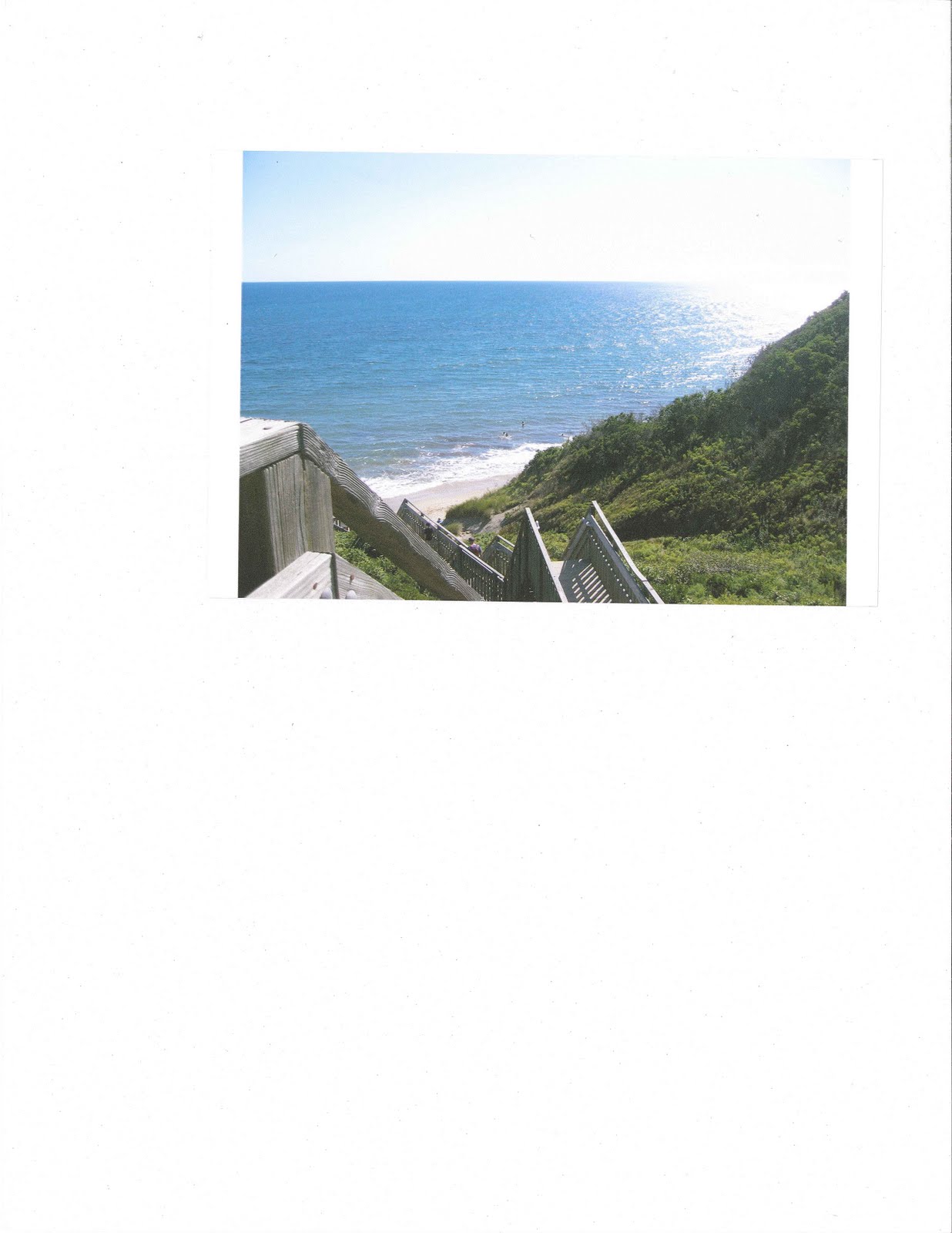
The photo of the staircase and the sea was taken at Mohegan Bluffs, a family favorite, and the other two photos are of the Rodman's Hollow plaque and a view over it. "It" refers to a 230-acre parcel of land that is considered the birthplace of conservation on Block Island. There is a wonderful hike through here and the preserve has the largest population of the state-endangered bushy rockrose in Rhode Island. Additionally, the also-threatened northern harrier feeds and nests here, and the only natural population of federally-endangered American burying beetle east of the Mississippi lives in the hollow.


For an island where there is supposedly not a lot to do, it surprises me that we always leave with a long list of things we didn't get to. This year, because of the hurricane, we didn't get to enjoy tapas on the great lawn of the Atlantic Inn. Or drinks on the fabulous porch of the National Hotel. Or sandwiches at Three Sisters. But at least we had an outdoor, candlelit dinner at the wonderful Manisses Hotel and we had the opportunity to see the new animals at the Abrams family farm (behind the hotel) and pet a baby alpaca. Then there was dinner at The Oar, games of bocce at the house we rented, Blocks of Fudge, Mansion Beach, feeding the ducks at the duck pond...the sparkling, late days of summer are over for the year on Block Island but they are still fresh in my memory. And one of these years I'll visit in the fall, which I'm told is an equally beautiful season.


Friday, November 11, 2011


'Littlefield Farm with Ferry,' Polaroid Transfer by Robin Langsdorf (Robin B. Langsdorf Photography, http://www.robinlangsdorf.com/)


I never would have imagined that it would take over eight weeks before I posted again, but then again, I also couldn't imagine that Hurricane Irene would cut my summer vacation on Block Island short (and leave us without power for five days) or that my daughter would need to have her appendix out (she also became a bat mitzvah in the middle of all this!) or that we would have a freak snow storm in October (that again left us without power). Anyway, we're all busy, but rather than continue to list reasons why it has taken me so long to return to my blog, I'll just get started again. I have so many wonderful things to share!


First, back to Block Island: we (my husband, daughter, brother-and-sister-in-law, and nieces)returned to BI for our seventh visit in late August, after not going for two summers in a row, and were reminded of how much we love this island. I've sometimes contemplated beginning a love letter to BI with that somewhat common phrase, "At the risk of ruining a good thing,...."; but I don't believe I have to do that because I don't think Block Island is on the brink of being ruined or is about to receive thousands of new visitors. The islanders have a very strong sense of what they want their island to be, which is decidedly not to be another Martha's Vineyard or Nantucket, which is refreshing. I have been to Nantucket three times in my life and once to the Vineyard, and they are both lovely; but I vastly prefer BI. to me, it reminds me of another one of my most favorite places on earth, Corsica. That may seem incongruous -- a mountainous, Mediterranean island and a relatively flat New England one -- but Corsicans, too, know what they don't want their island to be (the Cote d'Azur, the Italian Riviera) and they are fiercely protective of it.


One of the joys of Block Island is its twice-weekly farmer's market, held on Wednesdays and Saturdays. When we first visited, in 2001, the market only had about a dozen vendors, but today there are about twenty-five. There is some island produce, smoked fish, and baked goods for sale at the market, as well as island specialties like Littlefield Bee Farm honey products and Island Mist bath and body products, but there are also local artisans and it is this combination of vendors that makes the market so fun. It's rather remarkable how much time you can spend here after you stop to talk to everyone! Plus, as at other markets around the world, you can learn an awful lot about a place and pick up some great tips.


This year I discovered a photographer, Robin Langsdorf, who displayed her collection of unique Polaroid transfers, like the one featured above. These transfer works are only one project of Langsdorf's -- she's a terrific portrait photographer as well, and her travel work is impressive, too -- but she devotes her booth at the farmer's market to the transfers, which all feature Block Island scenes. (You can see the full range of her work at her own website, above, as well as at the Spring Street Gallery, across the street from the lovely Hotel Manisses and the longest running gallery on the island.) Langsdorf majored in journalism in college and was always very enthusiastic about taking photos, but it wasn't until she was traveling around Nepal and Varanasi, India twenty years ago that she was inspired to "get more serious" about developing her passion for visual storytelling.


I immediately fell in love with the Polaroid transfers, and Langsdorf, too, told me that when she learned the Polaroid transfer process she "began a love affair with this beautiful, painterly, impressionistic photographic art form. Sadly, Polaroid is no longer making this film." I knew I wanted to buy one or two of her images, but was having difficulty making up my mind which ones to choose. So I did something I always, always advise my readers to avoid: I didn't buy anything, figuring I would go to the Saturday farmer's market and decide then. Naturally, there was a hurricane, and naturally, I had to leave the island empty-handed. [Note to travelers: do not repeat my mistake, and adopt my (mostly observed) motto of "When in doubt, buy it now!" The likelihood of being able to retrace your steps to a particular merchant when it is open is slim, and, well, there's always the possibility of a natural disaster. One has regrets only for the roads not taken -- or the object not purchased!]


Before I had to evacuate the island (I didn't really have to evacuate, but it sounds much more dramatic) I did stop by the Spring Street Gallery to pick up one of Langsdorf's business cards, so I was able to get in touch with her later via e-mail, and I'm now the happy owner of the Littlefield Farm transfer above as well as another one of Mitchell Farm, which is, according to the Block Island Conservancy website, "one of the island's most cherished vistas, over 1,000 feet of road frontage with open field landscape." The Mitchell Farm Campaign raised the funds needed to complete an easement acquisition, and again to quote from the website, "those 1,000 feet are as important to Block Island's sense of community as is the overlook at Rodman's Hollow" (more about Rodman's Hollow in my next post). Family member Adrian Mitchell noted that "my values about what is important in life were shaped right here on Mitchell Farm in view of the sea and these green pastures. I want future generations to see this place as I have and be nurtured by it." My transfer prints are in appropriately rustic, wooden frames, and they are daily reminders of my many visits to this special island.


As for Langsdorf, she recently left for Brazil, where she has family members, and she is working on a series of Polaroid transfer prints collaged with photos of her family taken during the early part of the 20th century in Prague. It's set to debut in 2012, and I, for one, can't wait to see it!